Category: MSK

Rabies [notifiable disease]

Recent Incident: Bat contact was not recognised (effectively touching a bat without gloves means treatment is recommended)

Important: Rabies Vaccine is in short supply and we must do a UKHSA risk assessment.  Call RIgS 09:30-17:00 7 days, Info required HERE


Rabies is an acute viral encephalomyelitis caused by members of the lyssavirus genus. The UK has been declared “Rabies-Free”. However, it is known that even in  “Rabies-Free” counties the bat population posse a risk.

In the UK the only bat to carry rabies is the Daubenton’s Bat [Picture on the Left] and this is not a common bat in the UK. The UK and Ireland are Classified as “low-risk” for bat exposure. Despite our “low-risk” status in 2002 a man died from rabies caught in the UK from bat exposure.

Although rabies is rare it is fatal so we must treat appropriately, Public Health England – Green book details this.

Risk Assessment

To establish patients risk and thus treatment you need to establish the Exposure Category and Country Risk [Link to Country Risk]

Exposure Category

Combined Country/Animal & Exposure Risk
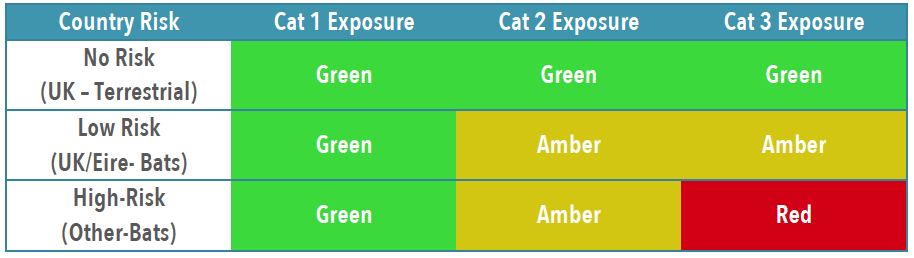
Treatment

Obviously patients with wounds will need appropriate wound care and cleaning, specifics for rabies are below.

If in ANY doubt, or you feel you need advice about treatment contact: On-Call Microbiologist (who will contact PHE or Virology advice)


You will likely need to liaise with the duty pharmacist to obtain vaccine or HRIG – which may need to be sent from a different hospital. [it is probably worth trying to obtain the 1st weeks treatment if possible, to avoid treatment delays]

IN HOURS 08:30AM-5PM PLEASE CALL PHARMACY TO INFORM THEM TO EXPECT A DELIVERY OF IMMUNOGLOBULIN SO THIS CAN BE SEGREGATED FOR THE CORRECT PATIENT. PLEASE ASK TO SPEAK TO THE RESPONSIBLE PHARMACIST                      CRH (4218/4279) HRI (2422/7123) 


UKHSA Rabies and Immunoglobulin Service (RIgS)

  • Telephone: 0330 128 1020

Routine operating hours: 09:30–17:00, seven days per week, including weekends.

All patients presenting with a possible rabies exposure should undergo an initial clinical assessment, including wound management, assessment of the exposure and previous vaccination history.

During routine hours: Contact RIgS for specialist risk assessment, advice on post-exposure vaccination and any requirement for human rabies immunoglobulin (HRIG).

Outside routine hours:

  • For the highest-risk exposures in patients who have not received their first post-exposure vaccine dose, contact the UKHSA emergency duty doctor service. These include head or neck exposures (excluding UK bat exposures under this specific criterion) and exposure to an animal confirmed to have rabies.
  • For other potential rabies exposures, administer a dose of rabies vaccine if the patient has not yet received vaccine, or if a scheduled dose is due, provided vaccine is available locally.
  • Contact RIgS after 09:30 the following day to complete the risk assessment and confirm further treatment.

All advice and administered treatment must be documented in the patient’s clinical record. Pharmacy must be informed of vaccine and HRIG administration, and arrangements made for subsequent doses.

HRIG: Indications, dosage and administration must follow the current UKHSA interim recommendations for HRIG use (June 2025), alongside the national rabies post-exposure treatment guidance.

Information required for next morning referral – HERE


Non-Major Trauma Pelvic Fractures in Older Adults

The vast majority of non-major trauma pelvic fractures presenting to Calderdale & Huddersfield A&E will be fragility fractures in elderly patients — almost exclusively:

  • Isolated pubic rami fractures (anterior ring, FFP-I)
  • Pubic rami fractures with concurrent non-displaced sacral fracture (FFP-II)

These represent 84% of all elderly pelvic fractures nationally, and virtually all are non-operative injuries by definition. The remaining cases are a small minority and are addressed in the referral criteria below.

Read more

Toddlers Fracture

Toddlers Fractures

  • Typically occur between 9months and 4yrs of age.
  • After a low energy twisting injury, such as;
    • Slipping and twisting while walking/running/jumping
    • Leg caught when sliding off parent/chair/toy
  • Clinical Features:
    • Wont put foot down
    • Not walking
    • Often little tenderness
    • Gentle twist of ankle and knee will be painful
  • Xray features:
    • Spiral fracture tibia (often seen best on lateral view
Read more

Penthrox (Methoxyflurane)

Penthrox is an inhaled, patient controlled analgesic for use with moderate to severe acute pain associated with trauma.  Not to be used in atraumatic pain, chronic pain, children or pregnancy.

Rapid onset of analgesia lasting 25-60 minutes depending on rate and depth of inhalation.  Wears off 10 minutes after last inhalation.

Contraindications (CHECK ALLL FM):

Read more

ASPEN Collar fitting

Fitting ASPEN collars is import – for both the comfort and function of the collar. The DENS study has been looking at the effectiveness on collars in peg fractures. Preliminary results suggest limited benefit, which made be due to the fact the many patients remove the collar early as not comfortable.


APSEN Training Video


ASPEN VISTA (adjustable) – Coming Soon

Hip Dislocation – Flowchart

Dislocation of a Native Hip

  • Uncommon – High-Energy injury
  • All patients presenting with a suspected native hip dislocation following trauma (including falls from standing) must have a primary survey done to assess for other injuries.
  • Early Senior input (if not trauma team) and Resus
  • Neurovascular status of the affected limb must be assessed and documented. 

Dislocation of Prosthetic Hip

  • Relatively common and frequently low energy
  • All patients should be assessed with low threshold to treat as trauma
    • Remember the biggest cause of ISS >15 Major Trauma in UK is older patients falling from standing height
  • Neurovascular status of the affected limb must be assessed and documented. 
  • If there is neurovascular compromise then move to Resus and inform ED senior 
Read more

Intranasal Fentanyl

There is was a national shortage of Intranasal Diamorphine therefore many departments are now more comfortable using Intranasal Fentanyl as a replacement for rapid provision of opioid analgesia in children.

  1. Intranasal (IN) fentanyl is a safe, non-invasive and effective analgesic for children with moderate to severe pain
  2. Fentanyl should be used in combination with non-pharmacological and other pharmacological pain management
  3. It can be used in conjunction with nitrous oxide for procedural sedation or prior to procedural sedation with ketamine

Dose is 1.5micrograms/Kg for the initial dose and 0.75micrograms/kg 10 minutes later if required.

Drug Delivery

Draw up the appropriate dose plus 0.1ml to allow for the dead space in the Mucosal Atomizer Device

Attach the MAD to the syringe

Sit the child at 45 degrees insert MAD loosely into the nostril and press the plunger

Doses greater than 0.5ml should be split between 2 nostrils


Contraindications

  • Blocked nose due to upper respiratory illness or epistaxis
  • Respiratory depression
  •  Hypovolaemia
  • Altered consciousness
  • Hypersensitivity to fentanyl
  •  Children below 1 year old

Full Intranasal Fentanyl SOP

Limping Child

This is a relatively common  presentation within the ED that has a myriad of possible diagnoses ranging from sprain to malignancy. One thing to remember is that patients and relatives will look for a traumatic reason for limb pain, and may link it to minor injuries that would not have caused it.  Read more