Dog, and other mammalian bites, are a common presentation with the ED.
They can be easy to treat, but need some particular attention if we are going to get them right.
Dog, and other mammalian bites, are a common presentation with the ED.
They can be easy to treat, but need some particular attention if we are going to get them right.
YAS crews may on occasions (rarely) bring us a Major Trauma patient that meets the criteria for bypass to the MTC because they have a problem that the crew cannot manage, or they won’t survive to LGI e.g. an unmanageable airway/ incompressible haemorrhage. In these instances we will get a pre-alert either from the crew or more likely the Major Trauma Triage Co-ordinator in EOC with some information but primarily the reason the patient is coming to us.
RCEM 2022 Safe sedation in the ED and RCEM Ketamine for paediatric procedural sedation guideline. Please read these documents in full or participate in RCEM learning for further information.
This guideline is a brief summary of the RCEM 2022 Safe sedation in the ED and RCEM – Pharmacological Agents for Procedural Sedation and Analgesia in the Emergency Department – March 2020. Please read these documents in full or participate in RCEM learning elearning for further information. Read more
Bleeding under the nail from blunt trauma can be very painful. Lucky we have the tools on hand to ease some of that pain.
A new burns referral pathway has been developed with Mid Yorks to securely send images of the patients burn. Allowing the burns team to arrange the most appropriate follow-up for your patient.
This requires BOTH online referral & phone call
A common sporting injury, especially in disciplines that require stop start sprints or rapid changes of direction
Recent Incident: Bat contact was not recognized (effectively touching a bat without gloves means treatment is recommended)

Rabies is an acute viral encephalomyelitis caused by members of the lyssavirus genus. The UK has been declared “Rabies-Free”. However, it is known that even in “Rabies-Free” counties the bat population posse a risk.
In the UK the only bat to carry rabies is the Daubenton’s Bat [Picture on the Left] and this is not a common bat in the UK. The UK and Ireland are Classified as “low-risk” for bat exposure. Despite our “low-risk” status in 2002 a man died from rabies caught in the UK from bat exposure.
Although rabies is rare it is fatal so we must treat appropriately, Public Health England – Green book details this.
To establish patients risk and thus treatment you need to establish the Exposure Category and Country Risk [Link to Country Risk]

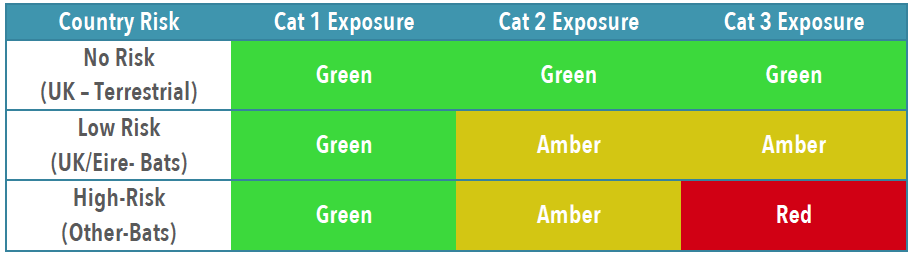
Obviously patients with wounds will need appropriate wound care and cleaning, specifics for rabies are below.
If in ANY doubt, or you feel you need advice about treatment contact: On-Call Microbiologist (who will contact PHE or Virology advice)

You will likely need to liaise with the duty pharmacist to obtain vaccine or HRIG – which may need to be sent from a different hospital. [it is probably worth trying to obtain the 1st weeks treatment if possible, to avoid treatment delays]
IN HOURS 08:30AM-5PM PLEASE CALL PHARMACY TO INFORM THEM TO EXPECT A DELIVERY OF IMMUNOGLOBULIN SO THIS CAN BE SEGREGATED FOR THE CORRECT PATIENT. PLEASE ASK TO SPEAK TO THE RESPONSIBLE PHARMACIST CRH (4218/4279) HRI (2422/7123)
Rabies and Immunoglobulin Service (RIgS), National Infection Service, Public Health England, Colindale (PHE Colindale Duty Doctor out of hours): 0208 327 6204 or 0208 200 4400